 FDE Jobs
Forward Deployed Engineer Roadmap
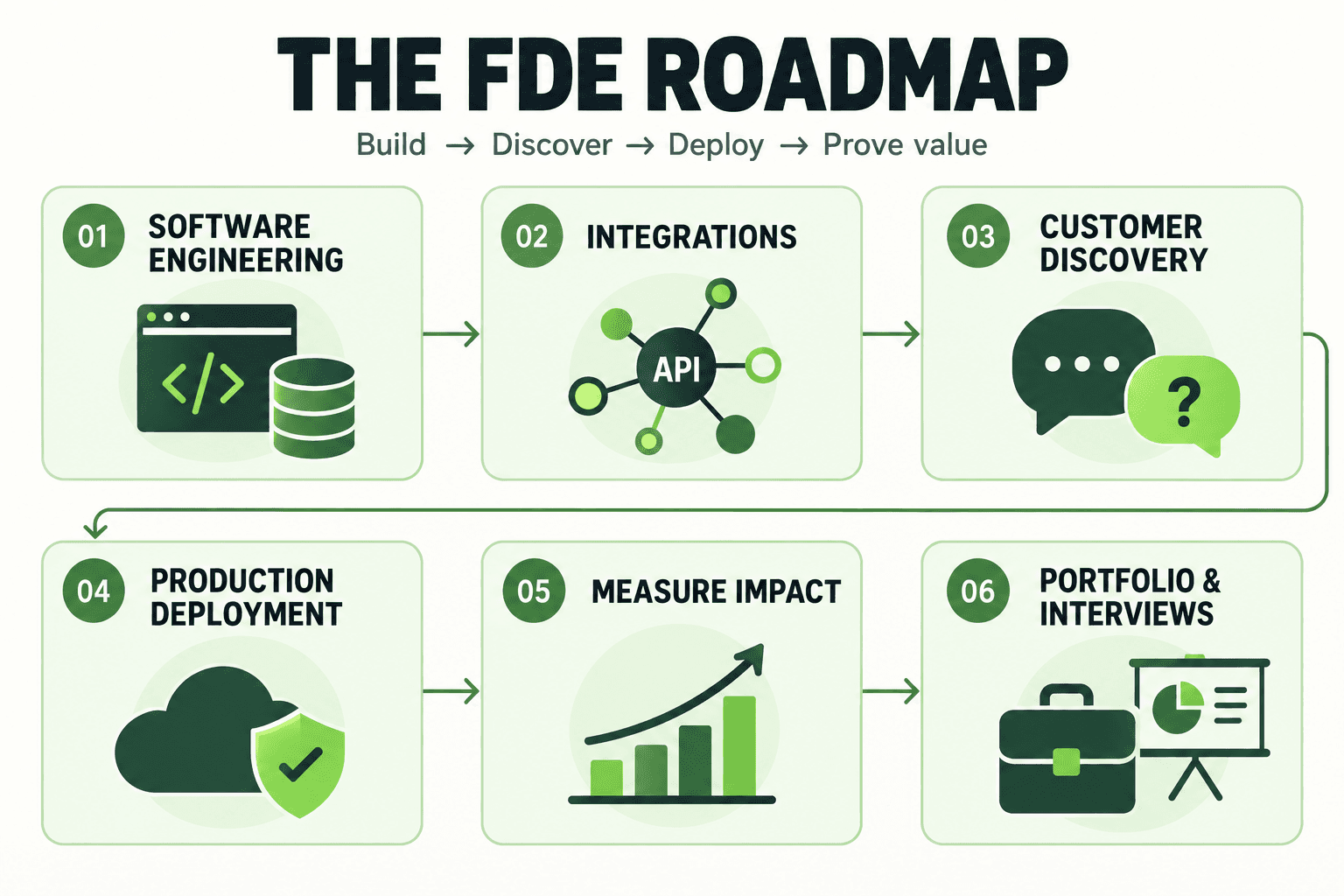
How to become an FDE: grow from strong software engineering to customer discovery, production delivery, and measurable impact. Use these six stages to plan what to learn—and what to build to prove it.
What is a Forward Deployed Engineer?
A Forward Deployed Engineer (FDE) works at the intersection of engineering and customer delivery. Instead of only building a feature from a fixed specification, you help uncover the real problem, design a workable solution, connect it to the customer’s environment, and stay involved until it works. Different companies use different titles and expectations, so read each role closely.
This is a skills-and-evidence roadmap, not a mandatory timeline. If you are already a software engineer, you may be ready to start with customer discovery and a real end-to-end project rather than relearning the basics.
The six stages of an FDE career roadmap
At every stage, produce something you can demonstrate—not just a list of technologies you have studied.
- 01Engineering fundamentals
Build a software engineering foundation
Be able to design, build, test, and debug a working application. Pick a backend language you can use confidently, learn SQL and APIs, and practice explaining your technical decisions. FDE work still requires real engineering depth.
Show your work: Ship a small application with tests, a database, and clear setup instructions. - 02Systems and data
Get comfortable with integrations
Connect services through APIs, handle authentication and permissions, map messy data, and plan for rate limits and failures. Customer environments rarely match a clean tutorial, so prioritize reliability over a happy-path demo.
Show your work: Connect two systems and document the data flow and failure handling. - 03Problem solving
Learn customer discovery and scoping
Turn a vague request into a concrete problem: ask who uses the workflow, what happens today, what constraints matter, and what success looks like. Propose a small first release and explain what you are deliberately leaving out.
Show your work: Write a discovery brief with clarifying questions, assumptions, and an MVP scope. - 04Delivery ownership
Deploy and operate in production
Move beyond the prototype. Practice deployment, access controls, privacy, monitoring, tests, and rollback. Know how to investigate an incident and who owns the system after launch. For AI applications, evaluate output quality and define human review and fallback paths.
Show your work: Deploy your integration with a runbook and a plan for common failures. - 05Customer outcomes
Measure adoption and impact
Agree on a useful measure before launch, then gather feedback from real users. Track whether the workflow was adopted and what improved. Distinguish outcomes you observed from results you merely hoped to achieve.
Show your work: Create a short case study with the initial problem, rollout, feedback, and evidence of impact. - 06Portfolio and interviews
Build your FDE story and apply
Show both sides of the role: sound engineering and good judgment with people. Explain how you clarified requirements, made trade-offs, shipped, and handled surprises. Compare job descriptions carefully; some FDE roles emphasize coding, while others emphasize solutions or deployment.
Show your work: Prepare a technical walkthrough, a stakeholder-friendly summary, and two honest interview stories.
One end-to-end project beats six isolated demos.
Find a real or realistic workflow with messy inputs and a user who needs it improved. Interview that user (or use a clearly labeled simulated scenario), define a bounded first release, build an integration, deploy it, and gather feedback. Document the decisions and results. That story demonstrates the work of an FDE far better than a collection of disconnected tutorials.
FDE roadmap FAQ
What does a Forward Deployed Engineer do?
A Forward Deployed Engineer works close to customers to understand their problem, build or adapt software, integrate it with existing systems, deploy it, and help make the solution useful in practice. The mix of coding, travel, and customer work differs by employer.
Do I need to learn AI to become an FDE?
Not always. Strong software engineering, integrations, deployment, and customer problem-solving apply across FDE roles. AI-focused roles may additionally expect model evaluations, data handling, and safe fallback behavior.
Can a software engineer transition into FDE?
Yes. If you already build reliable software, focus on customer discovery, scoping ambiguous requests, deploying in unfamiliar environments, and demonstrating outcomes. You do not need to claim customer-facing experience you have not had.